

Every Saturday I publish a column on everything I’ve watched or rewatched that week, plus whatever other ephemera drifts through my skull. Last week: The Sacrifice, Spider-Man, Splitsville and Dead Calm.
Appropriately for the biggest screen in Britain, the BFI IMAX is guarded like Troy. Its battlements are the busy Waterloo roundabout; its gates a network of dank underpasses best described as piss tunnels.
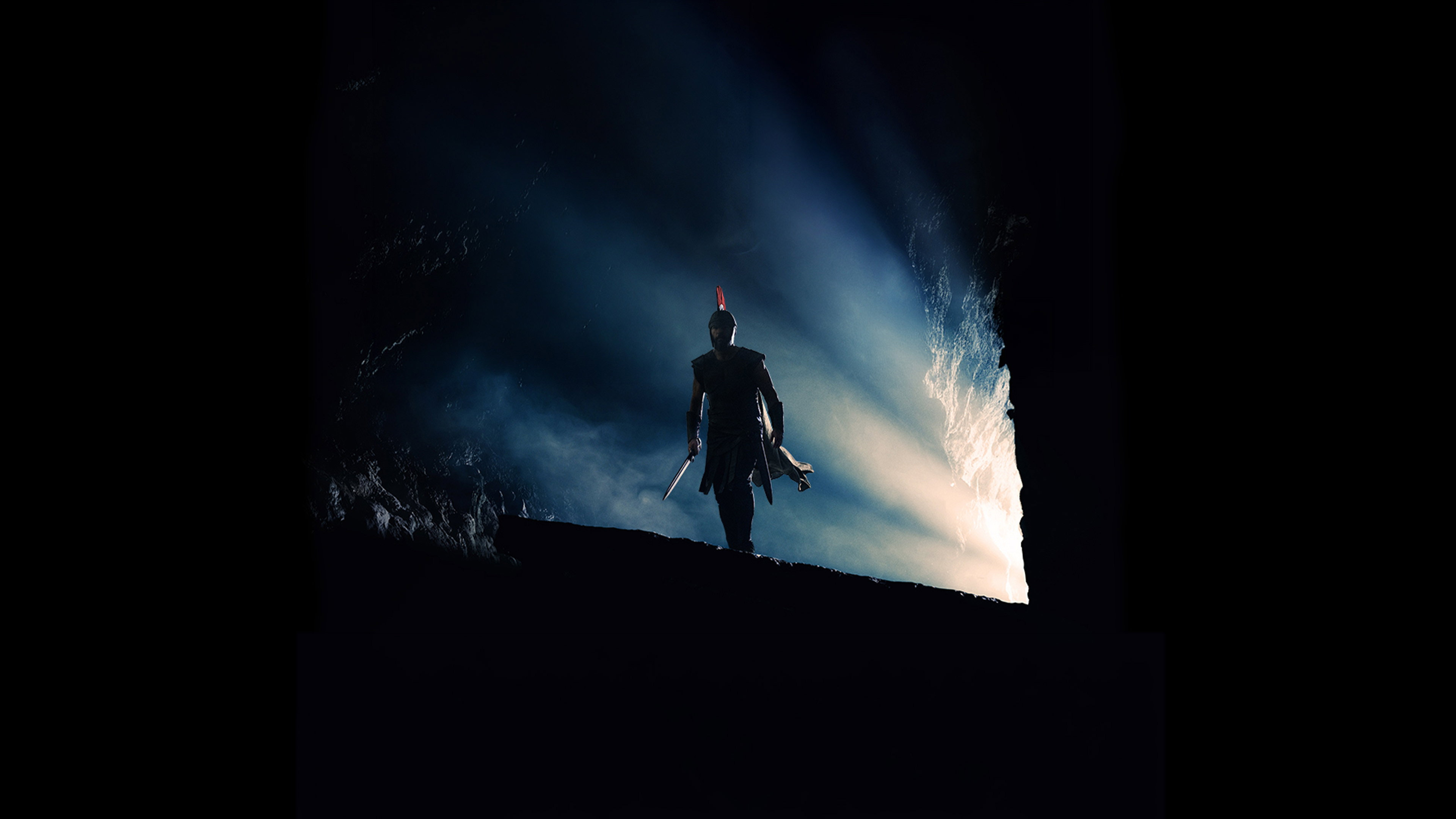
I hadn’t breached the cinema’s defences since 2024. This time I was there for my third viewing of The Odyssey, my first in 70mm. Seeing the film in its full glory confirmed what I already suspected: it’s a major work, perhaps Nolan’s best.
Christopher Nolan’s worlds are clean and clinical, almost puritan in their sexless order. Even his dreams are geometric contraptions (Inception); Rubik’s cubes mechanically constrained by a precise, mathematical logic. Homer’s The Odyssey is spectral. It is a world of gods and monsters; dreams and nightmares. To try and rationalise its wisp-like nature is to chain the god of wine himself.
On paper, Nolan appears to do exactly that. His decision to banish the Gods sounds like the kind of left-brained intellectualisation that led him to a more ‘realistic’ Batman. But this is not a coldly rational film, nor an atheistic one. As a filmmaker, Nolan is blessed with tools that Homer didn’t have. His gods exist in the film’s juxtaposition of sound and image, and in the seams of its edit. Represented cinematically, no talking God could be as celestially visceral as the cacophonous destruction of Odysseus’ ship after he has been lured “onto Poseidon’s ocean. Under Zeus’ sky.”
The secret sauce is Jennifer Lame’s edit, which balances Nolan’s blunter instincts with a slippery, elliptical style that achieves the sensation of a dream, if not the logic of one. She is unwilling to let the film’s muscular images stand as monuments to themselves, instead deploying a machine-gun-cutting style to bombard us with flashes that dissolve on contact. And she collapses time and geography: folding flashbacks into flashbacks; past into present. The combined effect is something like waking up from a dream and feeling the preceding night’s events slipping through your fingers. She is the Dionysus to Nolan’s Apollo.
Please support Rough Cuts by subscribing.
Prior to our siege of the BFI, we conquered the Prince Charles. Upon seeing its schedule for this insignificant August Sunday afternoon I felt what can only be described as a cinematic form of inceldom: an emasculated fury at what I, as a non-London resident, cannot have:
AMELIE (35mm)
A CLOCKWORK ORANGE (35mm)
RAN
ANGEL’S EGG
NIRVANNA THE BAND THE SHOW THE MOVIE
HUNT FOR THE WILDERPEOPLE
AKIRA
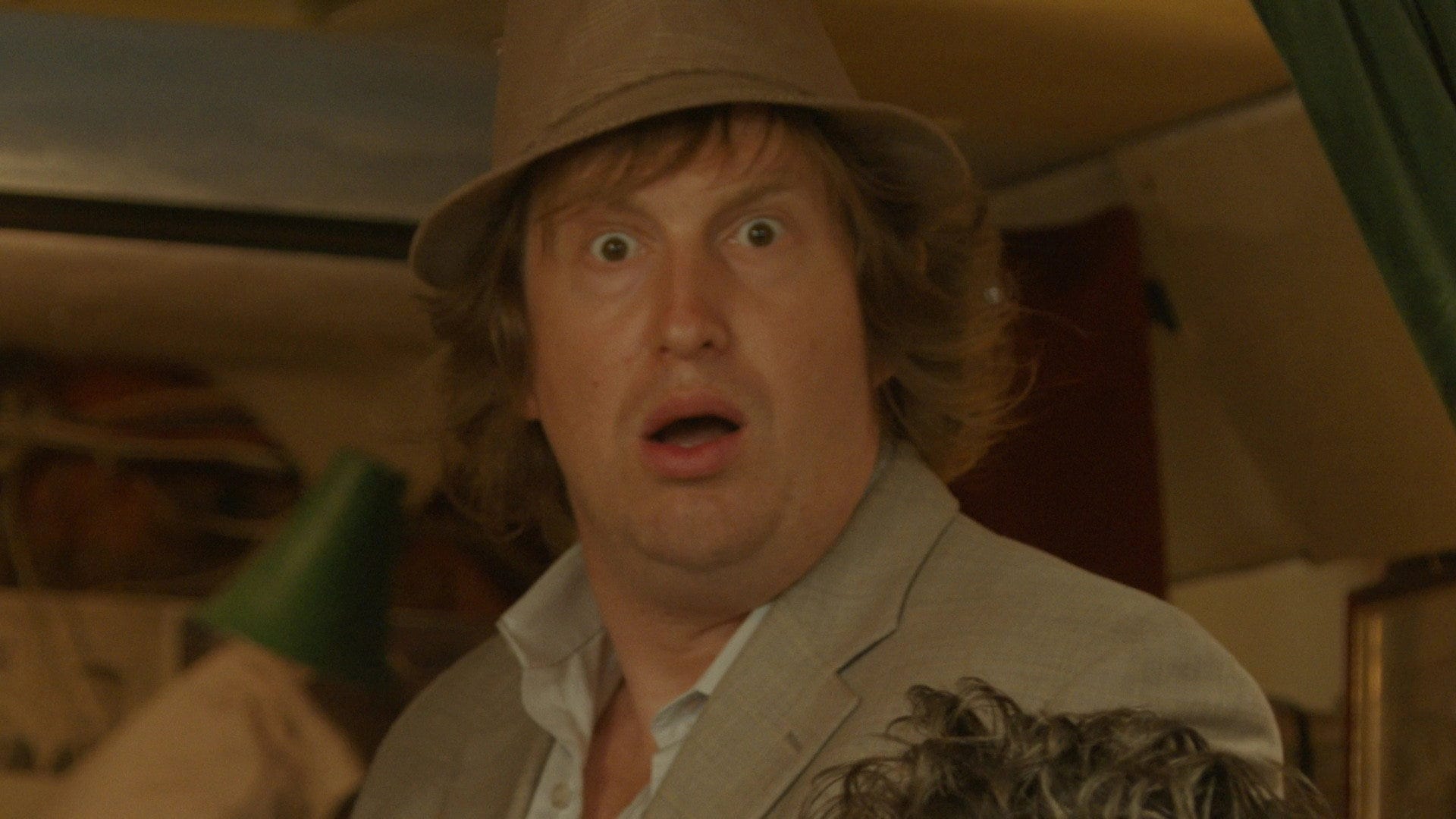
We were there for Nirvanna the Band the Show The Movie, a newish sci-fi comedy from Toronto duo Matt Johnson and Jay McCarrol, based on their cult 2007-2009 web series.
I wish I had something insightful to say about this film. I could tread water and spend a paragraph or so telling you the premise, but either you already know that or you’re familiar with Google. So I’ll just say that it was both the most I have laughed in the cinema, and the most I have heard a cinema laugh, this decade. It’s rare for a movie adaptation of a series to feel like anything other than an extended episode. This doesn’t. It’s an astonishingly ambitious film, both at the micro level (the guerrilla-execution of its set pieces and technical wizardry of its effects work are pretty breathtaking) and at the macro, in how it juices its defiantly lo-fi origins for the cinema without ever losing its identity. It’s as miraculous a balancing act as what Nolan and Lame achieved in The Odyssey.
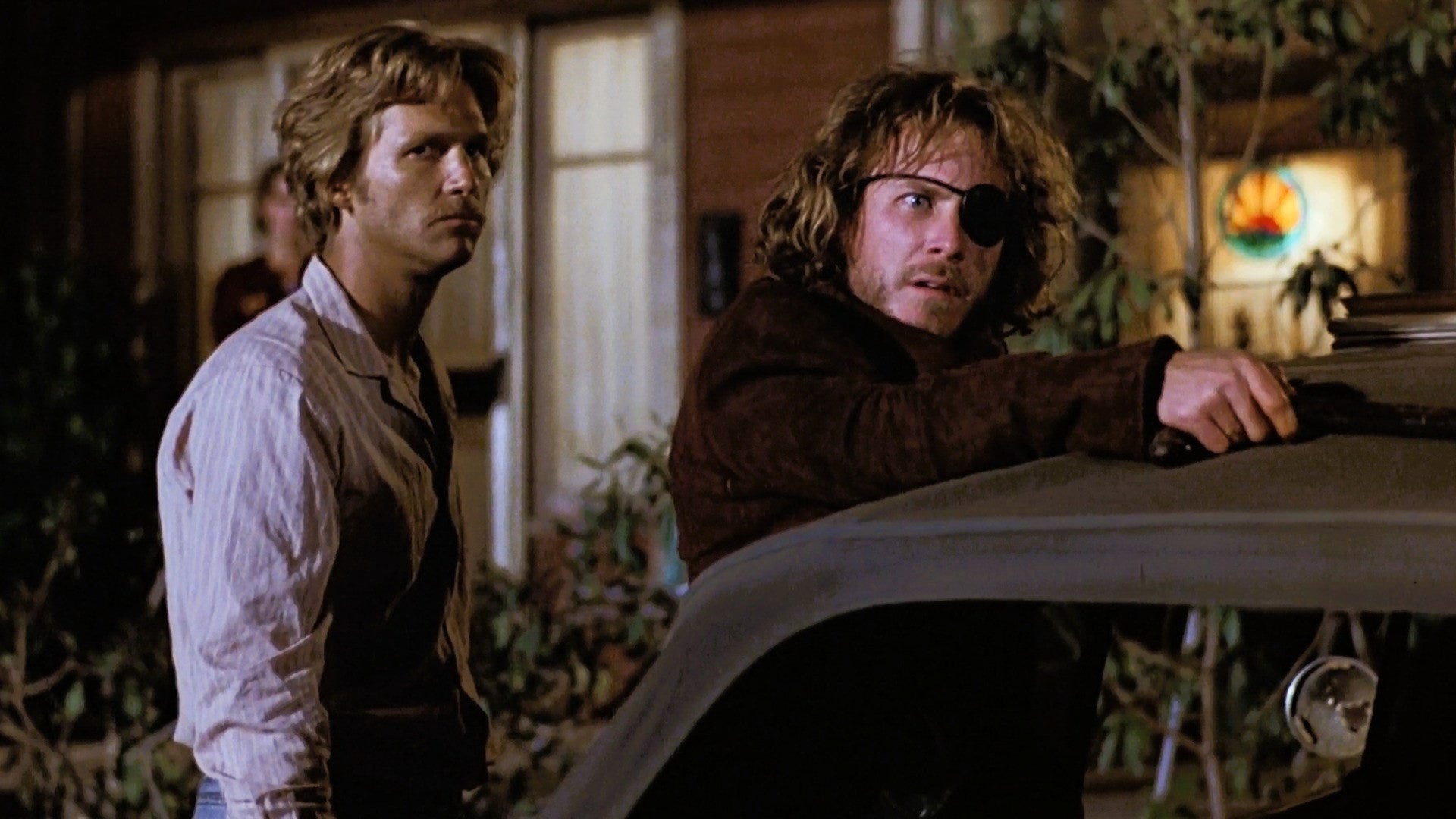
Ambition is in short supply among the protagonists of the excellent Cutter’s Way (1981), a minor-key noir I caught at home on a rather lovely Radiance 4K.
Noirs have a high floor. Even the genre’s lesser films, with their fleshy blend of sex, murder and mystery, will usually entertain, if little more. The best, though introduce a confounding element; a cross-rhythm that cuts against the central mystery. Here, it is the titular Alex Cutter, an impotently furious Vietnam veteran played right to the edge of caricature by John Heard. That he succeeds as a character is a credit to both the strength of Heard’s performance and Ivan Passer’s direction.
A moustache-wielding Jeff Bridges plays Richard Bone (what a name), a sleazily charming gigolo who ambles his way through the bedrooms of Santa Barbara’s upper crust. When he is wrongly blamed for a murder he believes was committed by a wealthy businessman, his friend Cutter becomes obsessed with the case.
Cutter is a wretched creature. Vietnam broke him, taking an eye, an arm and a leg in the process, and he has returned to a country that mocks him for his sacrifice. His disillusionment bursts from his body like splintered bone. He wants, needs, someone to blame. In the murder case, with its seeming moral straightforwardness, he sees a chance to make himself whole. Bone, who skipped Vietnam, has no such purpose. I’m realising as I’m writing this that their relationship is an oddly familiar parallel to the Elliot Page - Robert Pattinson dynamic in The Odyssey (exactly the kind of serendipity I was hoping this roundup format would produce).
Cutter’s Way fits into the time-honoured noir tradition of scheming idiots getting in way over their head. But Passer, who grew up in Czechoslovakia during the Nazi occupation and later fled after the Soviet invasion, does not approach his characters as insects under a glass. His film is empathetic, using plot as an excuse for character rather than the other way around. It is closer to the character studies of the New Hollywood than the sexy mysteries of the 1980s - more Klute than Body Heat.
Please support Rough Cuts by subscribing.
In sharp contrast to the muted colour palette of Cutter’s Way (an homage to the black and white of noir’s bygone era) is the lusciousness of Wong Kar-wai’s In the Mood for Love (2000), about a man and woman who fall in love after discovering their spouses are having an affair with each other.
The film creates mood through the accumulation of detail. Shadow on wall, spoon in coffee, mustard on plate, slippers on hardwood. The camera glides like a dancer’s dragging leg. The characters’ illicit meetings are shot through reflections or around corners, as though we’re peering in on something we shouldn’t be seeing. The streets and walkways are often strangely empty, almost purgatorial. Our leads flirt in subtext, rarely saying what they think, instead implying it by role-playing conversations with their spouses.
Richard Brody, the New Yorker film critic, recently made the point that a film’s “story” is a product of aesthetic choices. In other words, we can’t separate how we experience a story from the way it’s told.
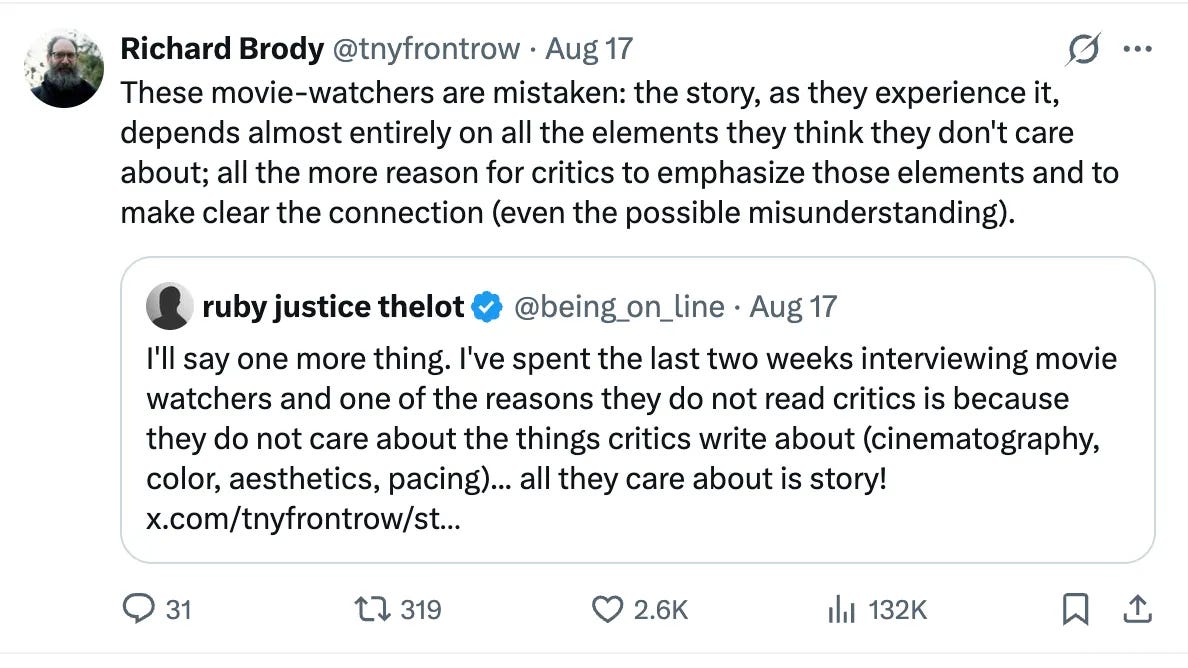
In the Mood for Love is a great demonstration of Brody’s point. All of these formal choices create a tone, yes, but they are also how we experience the repressed longing and sensory intensity of the story.
Am really liking this new format
Great piece on the Odyssey. I wish I had the 70mm experience! 💚 🥃