

Today’s article is FREE for everyone to read. Then, below the paywall, I share my thoughts on everything I’ve watched and read this week. Last week: The Odyssey, Nirvanna The Band The Show The Movie, Cutter’s Way and In the Mood For Love.
There was a Treehouse of Horror episode that terrified me when I was younger. For reasons I can’t recall, it ends with the Simpson family getting graphically turned inside out, revealing body-shaped bags of crimson guts and protruding bone.
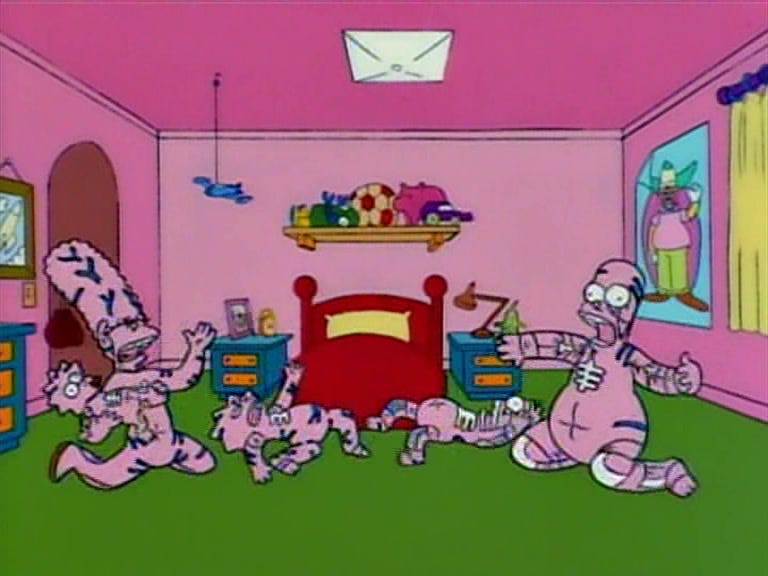
This is how I’ve felt over the last few months. The way I think about film, and much of what I read about it, has been pulled apart from the inside. The culprit is a series of blogposts written by David Bordwell dismantling “the One Big Idea that every intellectual has about popular culture.”
The Big Idea seems straightforward. Movies reflect how a society – or at least a significant section of one – thinks. By analysing a film, we can better understand a country’s mood and anxieties.
Common examples of this line of thinking include “X meets the moment,” “Y was produced by a country in a state of paranoia/fear/mourning/pride/anger,” and “Z reveals a country in thrall to bloodthirsty capitalism/wet-lettuce liberalism/patriarchal cruelty/the woke mind-virus.”
Seriously, you see stuff like this everywhere. I mean, look at this guff, from a 2025 article:
“Certain eras retreat into wish-fulfilment. The Reaganite 1980s unleashed a wave of ‘roided-up bodybuilders on enemies home and abroad. America was back, baby: bigger, meaner, and manlier than ever. Following the War on Terror, studios fed us morally straightforward fantasies of spandex-wearing heroes solving our problems with a wink, a quip and a well-timed punch.”
“In the aftermath of Watergate, the New Hollywood spat out tales of angry, suspicious men being crushed by vast conspiratorial systems, whether the government, the mob, or the family.
“When historians look back at 1970s cinema, they see a society processing the collective trauma of Watergate and Vietnam. When they look at 1999, they see one grappling with corporate alienation and the spiritual exhaustion of office life. In 20 years […] they’ll see a culture grappling with the post-social media, post-COVID, post-AI collapse of shared reality.”
(The author of all three of these paragraphs, by the way, was an amateur hack who goes by the name “Ed William.”)
So, what’s wrong with reflectionism? Let’s apply a few of Bordwell’s arguments to the aforementioned Watergate theory (which, to be fair to the amateur hack formerly known as Ed William, has been cited in far more prestigious establishments than this one).
The claim seems uncontroversial. All the President’s Men, The Parallax View, Three Days of the Condor and The Conversation deal with conspiracy and paranoia. They were released during or shortly after Watergate. Watergate was a big deal. Hey presto: the films reflect the paranoid atmosphere of mid-1970s America.
If you’re paying attention, you may have already noticed a flaw. Movies take a long time to get made. Often, films that Meet The MomentTM were conceived and produced long before The Moment existed.
The Watergate hearings began in May 1973. How many of these films were written and made by then? All the President’s Men passes the test, for obvious reasons. Three Days of the Condor is a little murkier, given that author James Grady started writing the novel it was based on sometime around 1971. But the film itself wasn’t shot until after Nixon’s resignation. So I’ll give it a pass.
The Parallax View partly fails the test. It was based on Loren Singer’s novel, which was published in 1970 and first developed as a screenplay in 1971. Production began in April 1973, just before the hearings. The Conversation definitely fails. Francis Ford Coppola started writing the screenplay in 1966 and finished in 1970. Principal photography was completed by the time the hearings started.
Already, the post-Watergate paranoia argument is under threat. Two of the main films held up as evidence were conceived before the break-ins had even happened.
This alone isn’t sufficient, of course. Regardless of when or why they were made, perhaps these films’ popularity is evidence that they captured the zeitgeist? In this case, the argument goes, the American public were thirsty for some paranoid movies because American political life had become so conspiratorial.
For this argument to work we’d need to establish that the films were popular. All the President’s Men and Three Days of the Condor certainly were - they were both among the top-ten highest grossing American films in their release year. But The Conversation and The Parallax View were not. If paranoid audiences wanted paranoid films, why didn’t they bother showing up to the latter two?
Even when a film is popular it doesn’t tell us much about why people saw it. Most people don’t go to the movies for politics. They could have gone to see Three Days of the Condor because they fancied Robert Redford, or because their dinner plans got cancelled. And there would have been a sizeable chunk of people who saw the movie and simply didn’t like it, or didn’t even consider its political resonance, or loved the fact that it made the CIA look powerful and scary.
And then we have to look at the other popular films in those years. In 1976, the year that All the President’s Men was released, the highest grossing film was Rocky, and the third highest grossing was A Star is Born. Joining them in the top ten were films like King Kong, The Bad News Bears and Midway. So what latent national emotion were all the people who loved these films tapping into? Nostalgia? Athletic achievement? Hubris? Name me a major political event, associate a mood with it, and I bet I will be able to find you a group of contemporary films that speak to that mood.
We haven’t even got into the fact that audiences aren’t demographically representative of the population at large, nor that Three Days of the Condor later became popular in the Soviet Union, where one can assume the zeitgeist was a little different.
You could argue that I have fixated unfairly on Watergate. Throw in Vietnam, both Kennedy assassinations and any other handpicked piece of 1960s and early 1970s historical flotsam, and one could argue the era’s movies were reflecting a deeper undercurrent of paranoia. Trouble is, now the argument becomes almost impossible to falsify. If we’re just pointing to a general paranoia, almost any thriller becomes malleable enough to fit into the theory. What evidence is there that this attitude existed, beyond the fact it was on the screen? And, even if it did exist, specifically how did it translate to the screen?
Reflectionism trades close readings of the choices made by filmmakers, and the traditions those filmmakers are working in, for sweeping statements about zeitgeists.
Repudiating reflectionism does not mean rejecting the importance of Watergate or paranoia to American cinema. But it does mean meeting each film on its own terms or, as Bordwell says, “by taking film as film.” Rather than seeing these films as a cultural reflux - a body politic spewing up whatever was upsetting its stomach - we can see them as a product of all kinds of (often contradictory) technical, commercial, historical, formal and aesthetic choices and traditions. The fun of writing and talking about film is in confronting and contextualising these choices and traditions.
A movie’s political or societal observations are embedded by the people who make the movies, not by society at large. These people each bring their own set of prior experiences (which often are dramatically different to those of the viewer). The Conversation speaks to a different paranoia (obsessive, guilty, personal) than Three Days of the Condor (institutional, impersonal). All the President’s Men and The Parallax View were both directed by Pakula and shot by Gordon Willis. Was the country paranoid or were they? How does 1971’s Klute, another Pakula/Willis surveillance thriller, fit in? What similarities and differences does it have to the post-Watergate films, and what does this tell us?
I’m just spitballing. There are thousands of different ways to tackle the films’ handling of paranoia without blandly citing a national mood. How is it embedded in their formal and aesthetic decisions? Where does the gesturing at current events read as cynical? What commercial or technical forces were at play? How has the thriller genre traditionally handled paranoia, and how do these films subvert or use these conventions?
Part of the problem is that culture sells. I note with amusement that the article I quoted above is my best performing piece on Substack. But, as Bordwell said, “movies are worth studying for themselves, not just as channels for Op-Ed memes.”
Below the paywall: my thoughts on The Devil Wears Prada 2, The End of Oak Street, Tony and Twilight of the Warriors: Walled In. If you enjoy my writing and want the unfiltered Ed Experience, please consider a paid subscription.