

This Book Tells You Everything You Need to Know About Special Effects
The lost guide to the arcane arts of illusion
Welcome to the inaugural edition of The Cinephile’s Bookshelf. In this new series, I hunt down rare, out-of-print and obscure film books and excavate their secrets. Today, we add our very first book to the shelf: Raymond Fielding’s The Technique of Special Effects Cinematography.
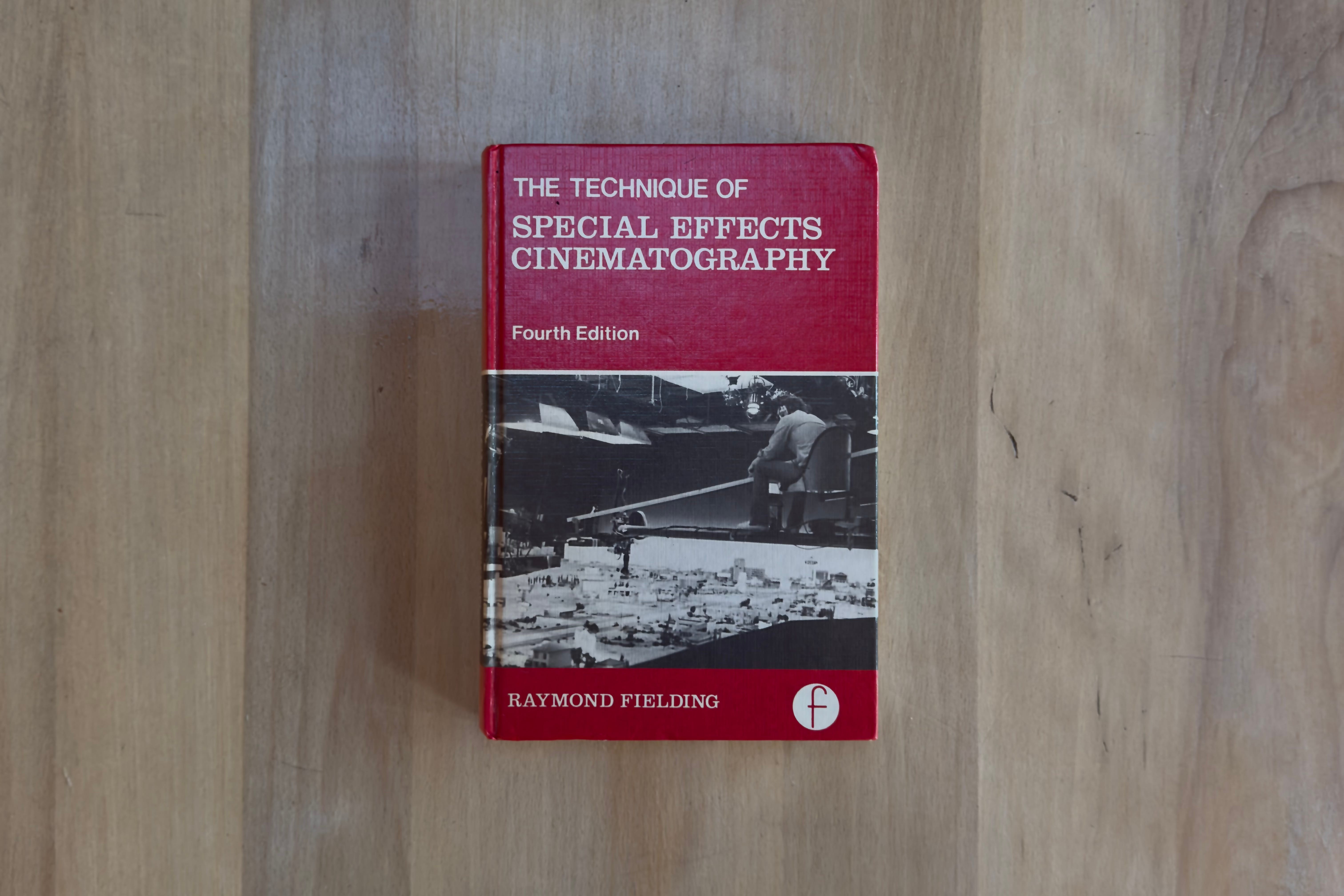
The Hunt
Visual effects wizard Phil Tippett describes first discovering The Technique of Special Effects Cinematography in a San Diego library:
It explained all of the techniques that you ever wanted to know up to that particular time, from the beginning of film history until the mid-sixties […] And so I stole this book. I stole it! Nobody ever checked it out. I don’t know how long it had been there. I took it home, and I read it from cover to cover many times.
Tippett wasn’t alone. The book was something of a sacred text in the latter half of the 20th century, detailing the arcane methods special effects technicians used to create convincing movie illusions.1
After seeing the book referenced a few times, I wanted to see what all the fuss was about. Alas, no copy was within stealing distance, so I started hunting. An early foray on Amazon was rebuffed: the book was on there, but for the princely sum of £154. I retreated.
Next, I turned to AbeBooks, where multiple copies were available for under £20. BUT WAIT! These were third editions (1972), not fourth editions (1985). That thirteen-year gap straddles a small, underseen arthouse film called “Star Wars,” which Mr Tippett happened to work on:
The story could stop here. But many years later, at the end of the eighties or in the early nineties, the book was reissued. The original was in black and white, and the new edition had a bunch of color pictures in it. It was updated. And among these pictures, you could see photos of me animating the AT-AT walker in Empire Strikes Back. I was in it!
This settled it. I needed to get the fourth edition. Eventually, I pulled the trigger on a nice-looking ex-library copy on eBay for a reasonable £30.
The Book
The book is quite handsome in a rugged, weatherbeaten kind of way. It has that no-nonsense, dust-jacket-free hardback binding style that would happily endure being bapped around for days on end in a student’s backpack. Funnily enough, that’s pretty much been what’s been happening to it: I’ve been lugging it around with me everywhere in anticipation of writing this post.
The Secrets
(A quick note here on the format for this series (this is the inaugural edition after all). I’m not going to try to summarise the books. That would be boring for me to write and even more boring for you to read. Instead, for each book, I will tease out a few surprising ideas that somehow change how I think about cinema today, and that I think you will find interesting. Over time, as we build our bookshelf, we should see these books begin to speak to each other in ways that lead us to unexpected places. Fun!)
In many ways, The Technique of Special Effects Cinematography is a tricky book to launch this series with. It is, first and foremost, a textbook: heavy on detail and procedure, light on argument or anecdote. I confess to skimming some of the more labourious sections on largely defunct technical processes (don’t quiz me on camera-light-tight boxes, power drives, or registration methods).
From today’s vantage point, though, this dry, technical handbook is laced with an almost wistful sadness. The techniques discussed range from the dead to the dying and have largely been replaced by digital alternatives. Reading it now resembles attending a Rolling Stones concert in 2026. It’s fun to sing along with the hits, but everyone knows it’s a nostalgia act.
Contrived analogy aside, this tension between how and why special effects were utilised then versus now is exactly what gives the book its vitality. Which leads me to…
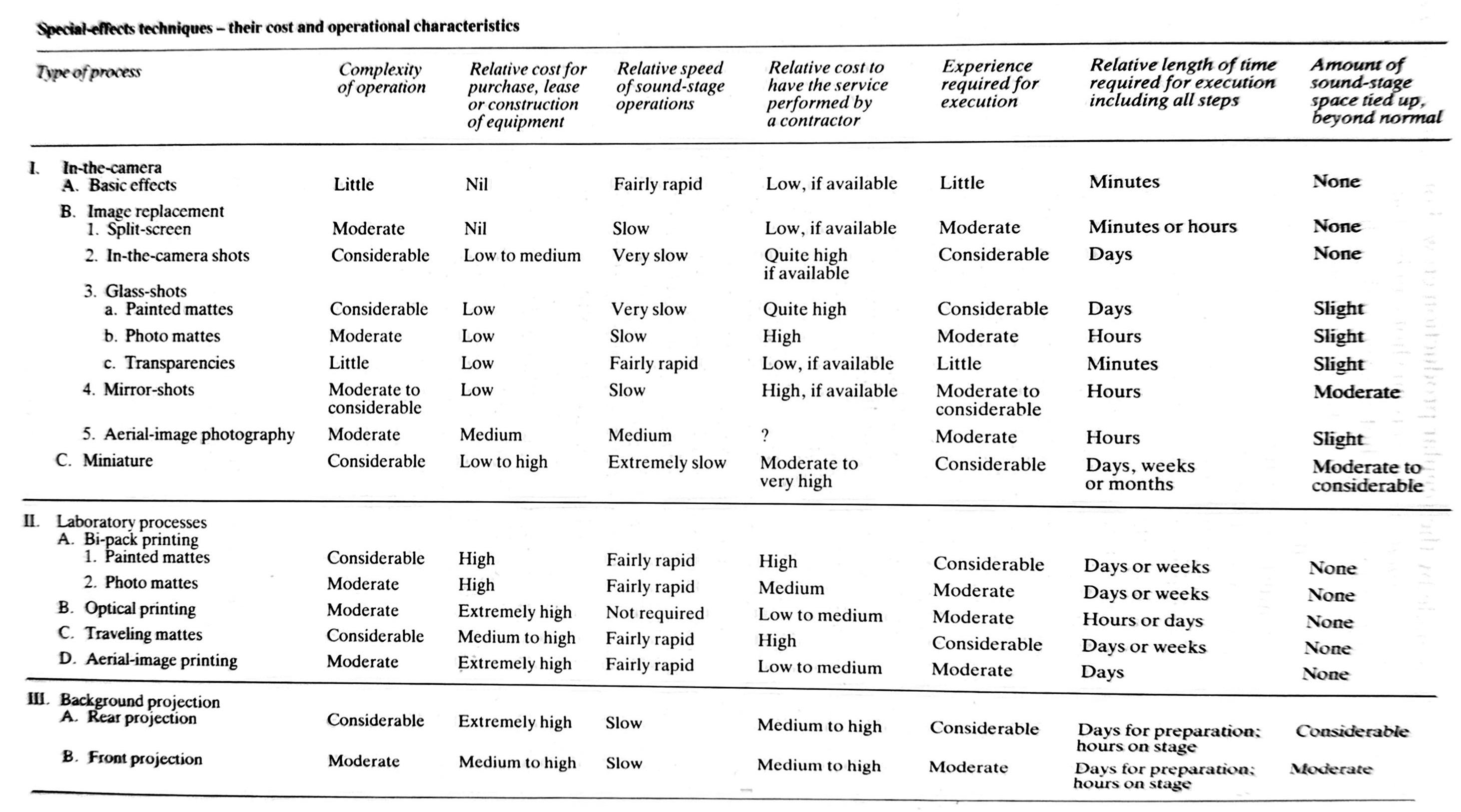
(1) Special Effects Were Supposed to Save Money
At every opportunity, Fielding hammers home a simple point. Special effects were conceived first and foremost as a cost-saving tool.
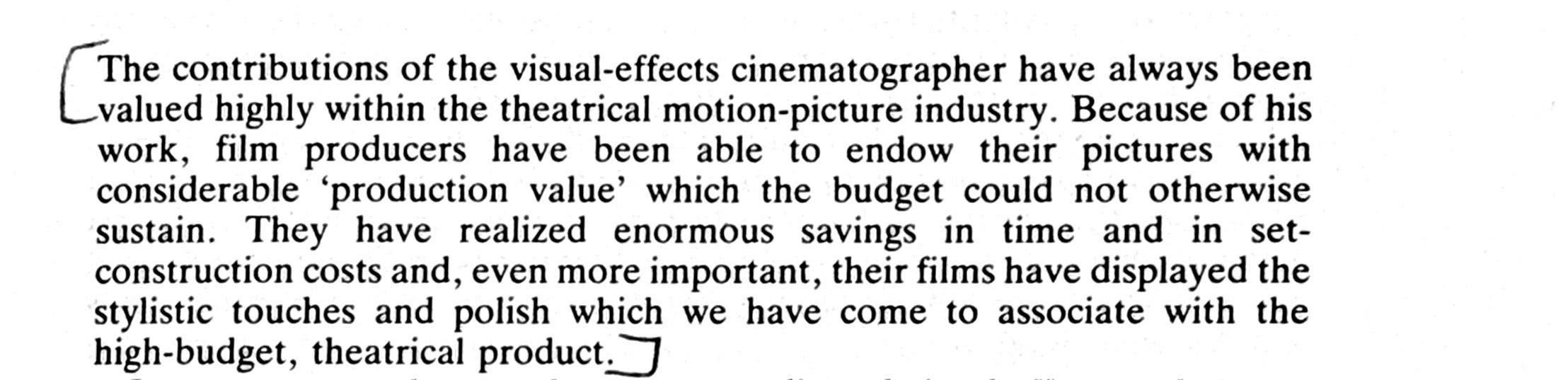
This may seem obvious in hindsight. Today, though, it’s quite striking. If someone told me that a film is “special effects heavy,” the first thing I’d think of wouldn’t be “cheap” or “efficient.” I’d assume the opposite.
Of course, the cost-saving function of special effects hasn’t disappeared. Many a low-budget filmmaker has used special effects (both practical and digital) to punch well above their weight. But, more frequently, we hear of expensive commercial blockbusters with frankly insane effects budgets. What gives?
The answer, I think, is that the function of special effects has bifurcated. The special effects Fielding covers in the book were first conceived to enable filmmakers to substitute reality. A matte shot could cheaply replace a cityscape; a miniature could substitute for a location shoot, etc.

This purpose still exists, albeit now largely fulfilled digitally rather than manually. But a new tradition has emerged. As special effects evolved into digital and visual effects, and as the industry’s imagination was captured by large, spectacle-driven genre pieces, the technology began to be used to create rather than substitute for reality.
Ambition scaled with the technology, resulting in fantastical (and expensive) creations that have no real-world stand-in. The ‘effects picture’ became an end in its own right, crowding out the cost-saving logic that emerged in the first place. As Fielding declares on the book’s back cover:
“Once intended to save money, special effects films have now developed into the dominant motion picture genre.”
(2) The Economic Logic of Special Effects
There is a romanticism to the techniques discussed in the book. Fielding writes of skilled artists painstakingly painting intricate church scenes onto fragile panes of glass; of miniatures built to mathematically precise dimensions.
There’s nothing wrong with this cosy, Noble Craftsman nostalgia, but we should temper it with the economic reality:
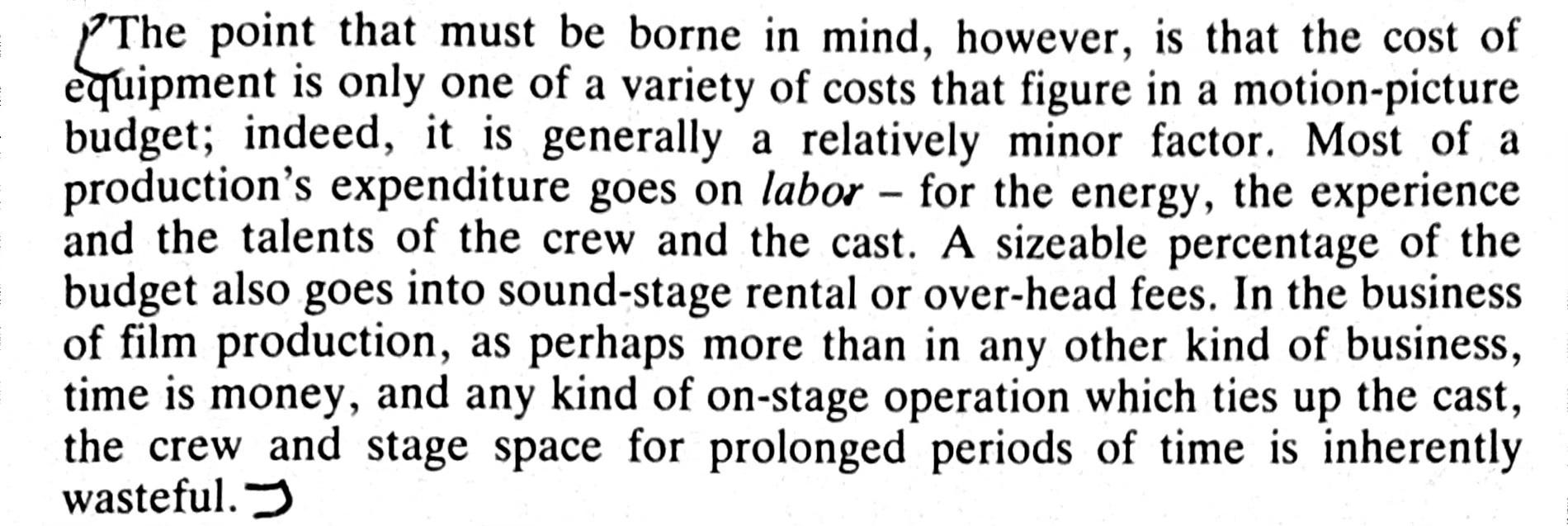
To paraphrase Fielding’s argument, certain special effects techniques were adopted because they moved work off the expensive, time-pressured set into a cheaper, less labour-intensive post-production environment. Artisanal skill was a byproduct of this economic logic.
This same economic logic drove the widespread adoption of digital tools a few years after the book’s publication. And today, this logic has reached its apotheosis. Companies make grand promises that individual creators, armed with nothing but a laptop screen, can produce entire worlds for little cost with a click of their fingers.
Maybe they’re right. But the book, taken as a whole, is an argument for what may be lost when friction is removed entirely…
(3) Not All Friction is Born Equal
There are two kinds of friction. One is creatively generative, the other is plain labourious. The great challenge in our increasingly frictionless age will be to retain friction where it is creatively beneficial.
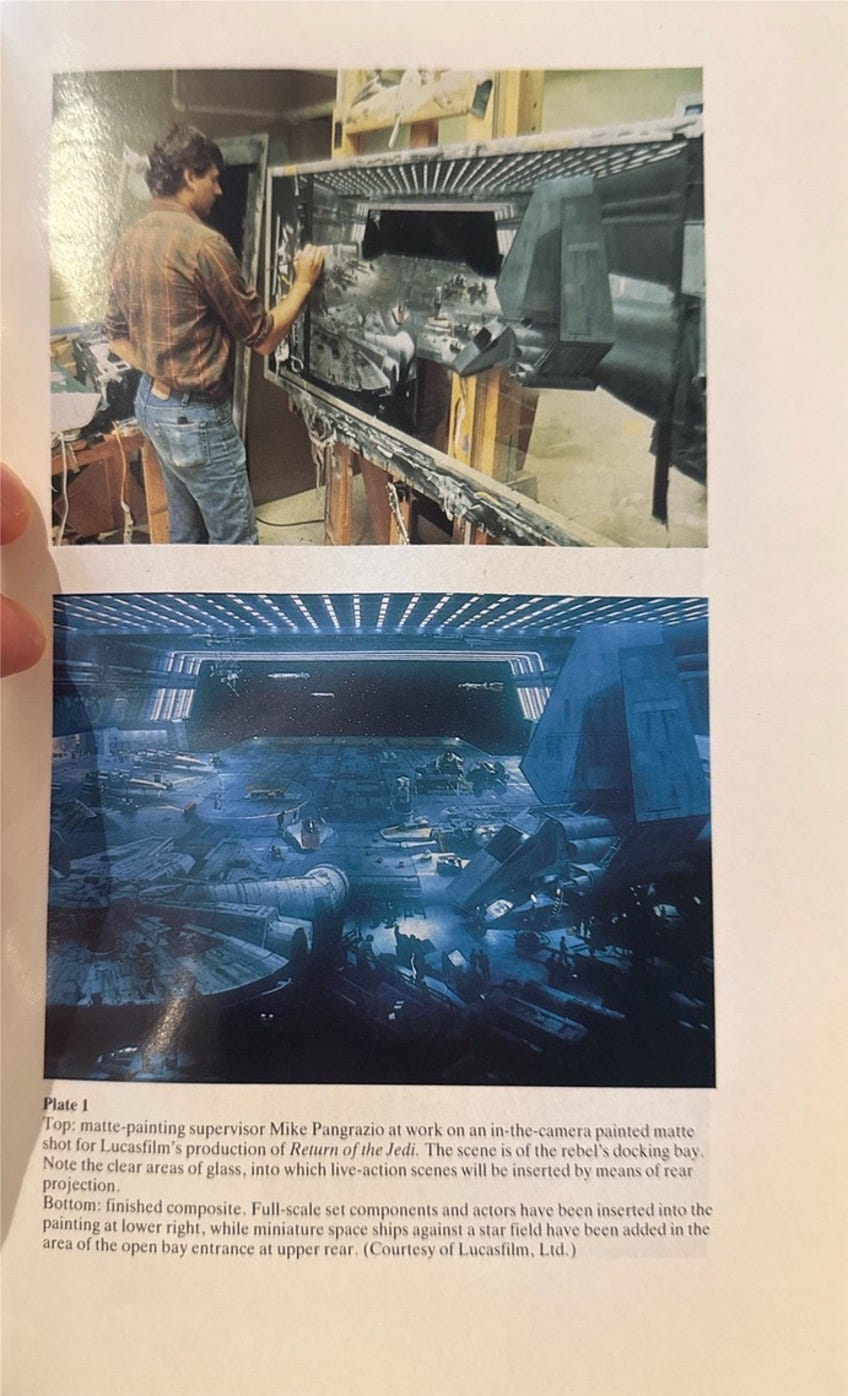
For example, early sections of the book spend a lot of time exploring glass shots. One of the earliest special effects techniques (first used in 1907), these required someone to paint missing elements of a scene onto glass. The shot would then be filmed through the glass, resulting in a composite image of the real world plus the painted-on elements:
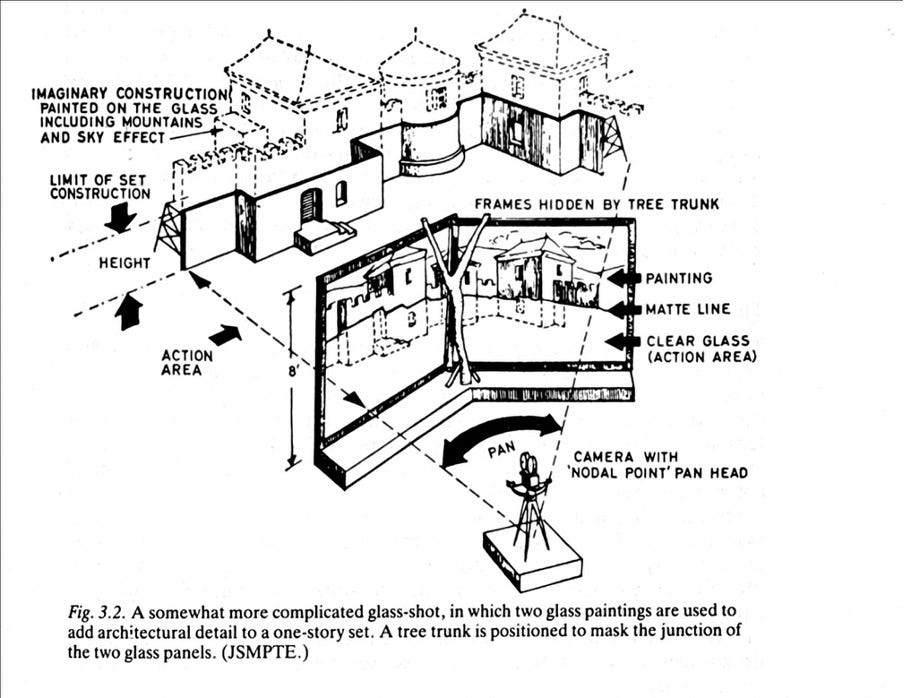
This is extremely impressive. It is also extremely slow. I’m sorry to the humble 20th-century glass painter whose livelihood I’m about to casually dismiss, but the replication of this skill with digital equivalents seems to me like an upgrade. If the function is to accurately represent a missing element of a scene, then a digital process that achieves that result more quickly and cheaply is a good example of eliminating ‘bad’ friction.
Then we have miniatures. These are so cool! Did you know there is a precise mathematical formula that dictates the camera speed used to record gravity’s impact on a model? Or that they are always built as large as possible (one tanker used in The Spy Who Loved Me was 63 feet long!)? Or that each model designed to be photographed further back in the frame must be built with progressively less detail in proportion to its reduction in scale?
If this all sounds complicated, it’s because it is. Fielding hammers home over and over again how inefficient, difficult and time-consuming miniatures are:

He argues that convincing miniature work involves a persistently frustrating uphill battle against the laws of physics. Though this process is stubborn and slow, when done well, it yields phenomenal results.
There is, for the record, no reason this effect isn’t possible to achieve digitally, and no reason that certain painful elements of the process (eg the calculation of the relevant formula) can’t be smoothed away. But it’s hard to shake the feeling that the mode of weightless and artificial CGI we encounter in many blockbusters today is connected to the smoothing away of the bloody, real-world problem-solving that miniatures and other forms of practical special-effects require. Sometimes it’s supposed to be hard!
The Bonus
Thanks for tuning into this first instalment. I’m still working on the format - I feel this edition may have been a little too long and dense in the middle sections. But hopefully you’ve liked what you’ve seen. Next time, we’ll add Parker Tyler’s Underground Film: A Critical History to the shelf: an entertaining, insightful and eyebleedingly convoluted polemic on underground film and the avant-garde.
As a final bonus, here’s some competency porn, in the form of diagrams I’ve scanned from the book. The skill, intelligence and practice required to pull off these techniques is so cool, akin to watching a great sports team or band in their pomp. Enjoy!
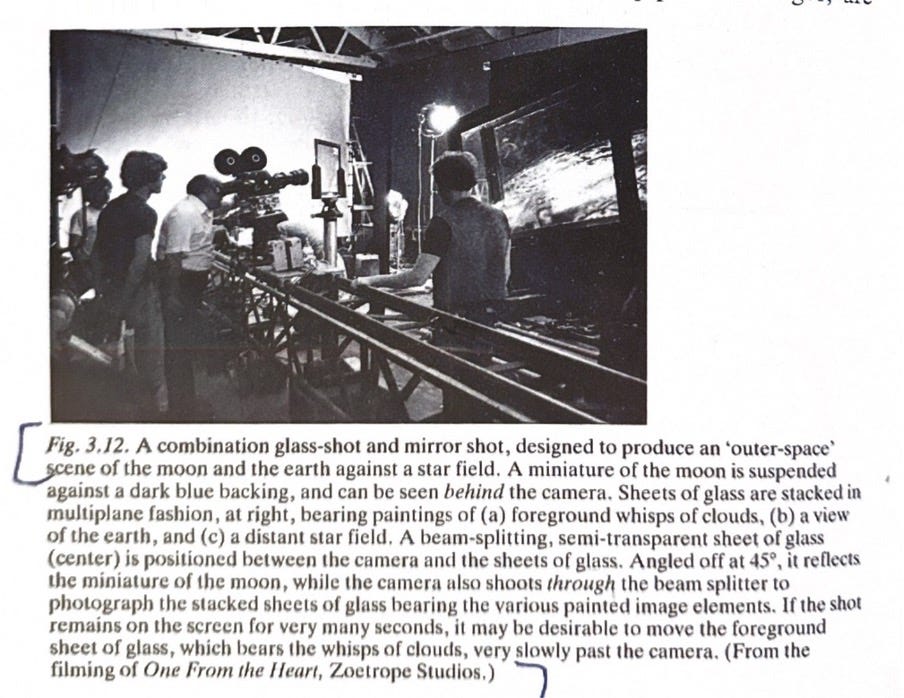
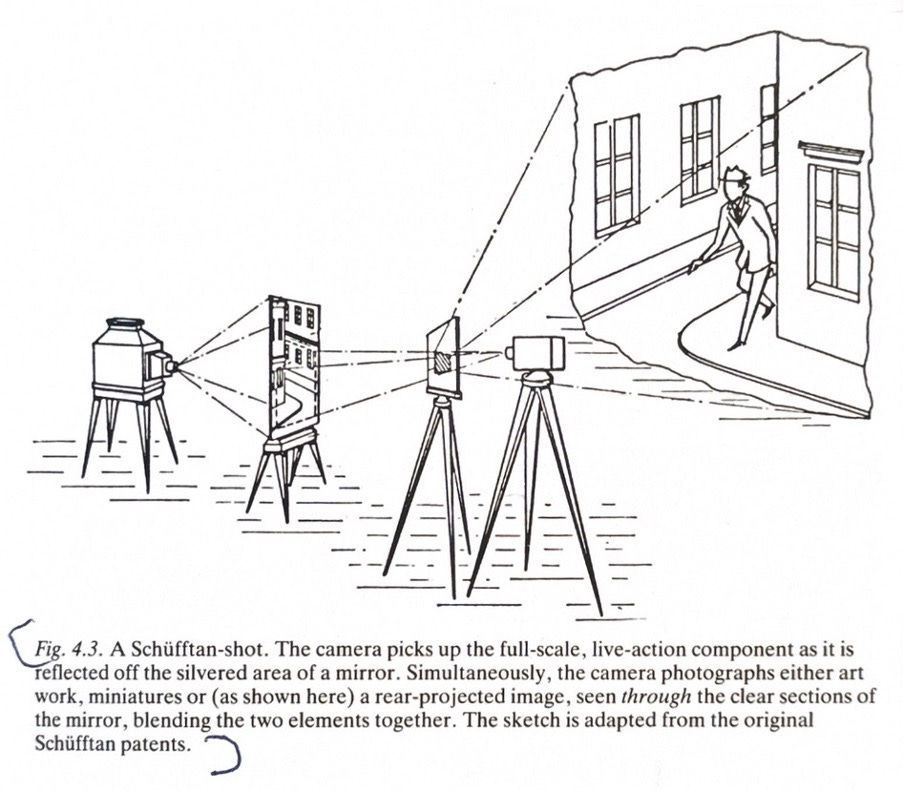
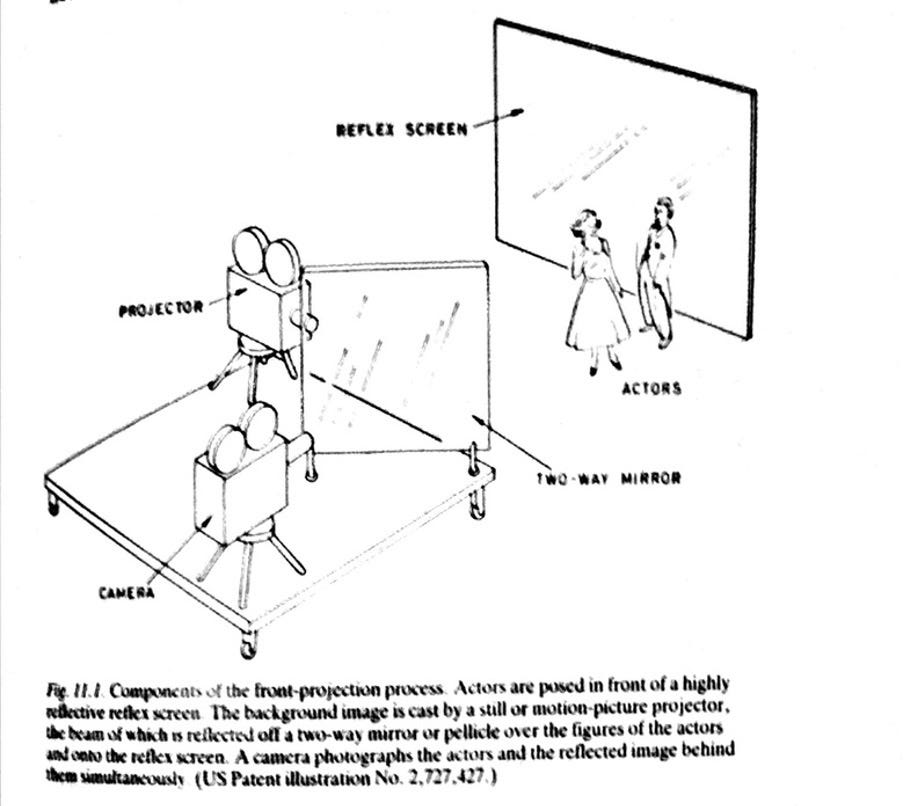
Today, “special effects,” “visual effects,” and “digital effects” all have slightly different meanings. We don’t need to get into all that here. I’m using “special effects” as an umbrella term for everything.
Hi. Write a book on this. I need more.
Very cool!
"Special Effects Were Supposed to Save Money"
😅